

The ledger
Every answer recorded once and shared with every agent after it. Your crew gets smarter. You get interrupted less.
For managers who already use AI agents
You are running one chat at a time and calling it automation. Guildwise HQ runs them like a team.
7-day free trialYour machines, your reposNothing leaves without approval
Refactoring the checkout service
“Should guests be able to check out without an account?”
Same question as yesterday, asked again.
Finished before lunch. Nothing queued.
1 of 4 agents working. You are the bottleneck, and you are the audit trail.
Three agents claimed three cards. All working in parallel.
Same agents. Very different Tuesday.
Capable agents are not the problem. Managing them is. Here is what changes when something does the managing.
You type, you wait, you read, you type. Every other agent sits idle.
Each agent claims its own card. They all work at once, and never collide.
You are the scheduler, the dispatcher and the standup.
Work flows through its stages on its own. Release steps are queued, not remembered.
Yesterday’s decision is gone from the chat. Today’s agent asks again.
The ledger records the decision and hands it to every agent that asks next.
The agent that wrote it says it is fine. It always says that.
Separate reviewers and testers. Large changes need two reviewers.
Scrollback is not a record. Nobody can say who approved what.
Every claim, answer and approval is an event that is never edited.
The bill is the first time you hear how much it cost.
A monthly budget per project. A warning at 80 percent, a pause at 100.
Posts to Jira, GitHub and email go out the moment they are written.
Outgoing posts wait in the outbox until you read, edit and approve them.
You ask each agent what it did, then write it down yourself.
One floor report each morning: what is stuck, what was solved, what it cost.
How it works
Three moves, and your agents stop waiting on you.
Builders, reviewers, testers, a technical writer and a business analyst. Give each a role, a model and a place to work: your own computer, a server or a GitHub Codespace, in a safe, walled-off space.
Write the work as cards, or let your BA draft them from Jira and GitHub. Each agent works on its own copy of your code, and a change reaches your main code only after review and testing.
Questions, approvals and alerts reach one desk, with context, options and a recommendation. You answer once. The crew carries on.
The product, for real
These are screenshots of the app itself, running on demo data.
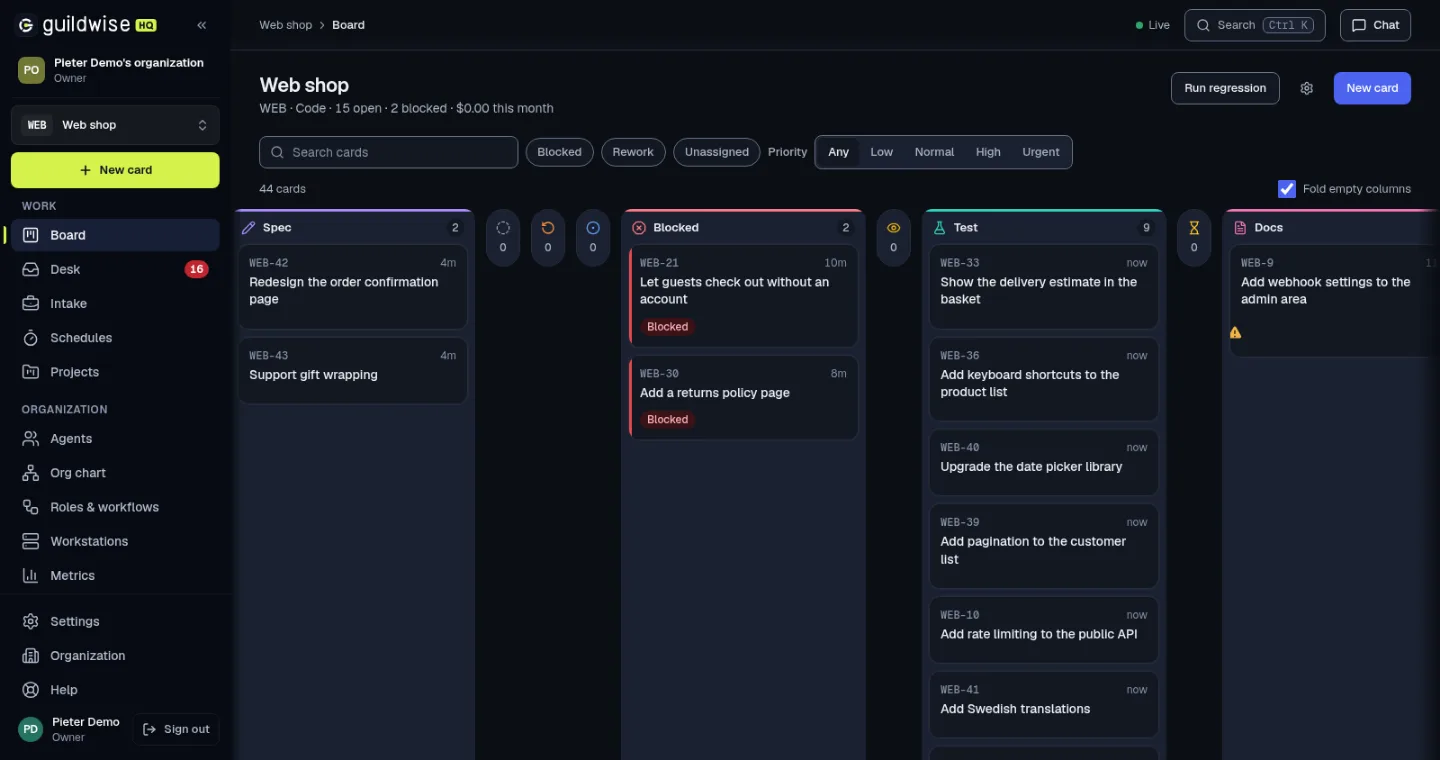
 Review and test are stages, not suggestionsOne agent per card, claimed exclusively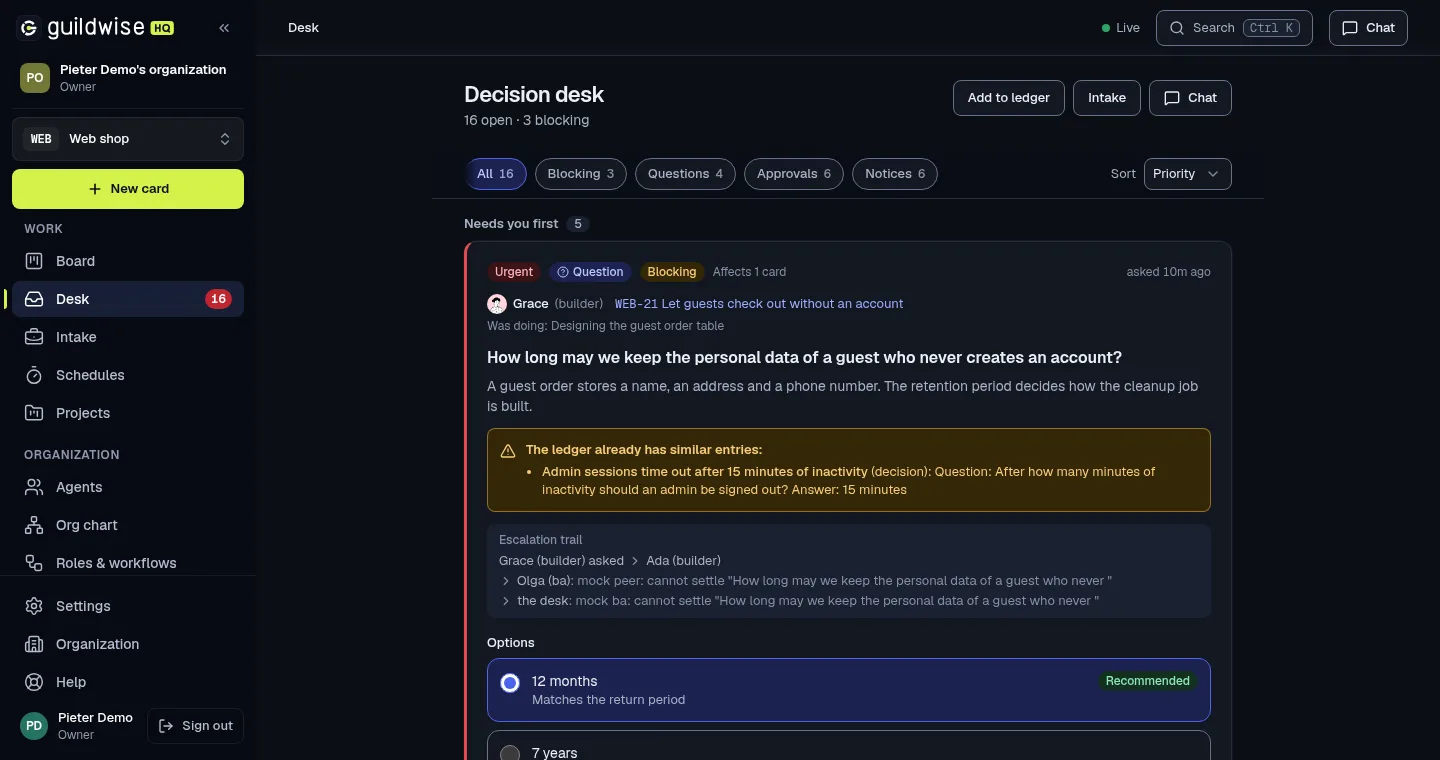
 The ledger already has a similar answerOptions with a recommendation
A day on the floor
While you were in meetings, the crew kept going. This is a sample from the demo organization, shown to give you the shape of it.
Illustrative numbers from a demo organization. They are not customer results or a benchmark.
The efficiency check
Eight questions, about two minutes. You get a score and a list of what you are leaving on the table.
Question 1 of 8
What you get
Not another chat window. A system that keeps a whole crew productive, informed and inside the lines.
Every answer recorded once and shared with every agent after it. Your crew gets smarter. You get interrupted less.
A monthly budget per project. A warning at 80 percent. At 100 percent new work stops.
Posts back to Jira and GitHub wait for you. No agent names, no internal details, nothing unreviewed.
Group cards into phases. Late bug cards hold a phase open. Deploy steps follow as soon as you approve them, so a release is a checklist you cannot forget.
Roles, departments and workflows, designed in a chat with your BA and approved by the Owner.
Your BA maps incoming tickets to projects and drafts cards with specs and test plans.
Recurring instructions, and side projects that agents pick up when they are idle.
Agents run on your own computer, a server you rent or a GitHub Codespace, each on its own copy of your code. A guided installer sets one up.
Private knowledge folders for the organization and for each project. They are kept with your own code and on your workstations.
Invite people as additional managers on a single project, and nowhere else.
For regulated and demanding teams
Guildwise HQ is built for the teams who are asked “who approved that, and where is the record?” You get the speed of a crew with the controls of a careful organization.
Audit trail Illustrative
Everything that happens is written to a log that is only ever added to. You can see what happened, in order, and who said yes.
Large changes before they reach your main code, DevOps actions and every outgoing post wait for a person. Agents propose; you decide.
Guildwise HQ is a hosted service. Your agents work on your own workstation, a server or a GitHub Codespace, and your code stays with you.
Knowledge vaults are kept with your own code, on your side, separate from company systems and from the model provider.
Authenticator codes and one-time recovery codes. Owners can require them for everyone.
Owner, Admin and Member, with agents and projects scoped to the organization they belong to.
What we do not claim. Guildwise HQ holds no compliance certification today, and using it does not make your organization compliant. It is designed around the controls reviewers ask for (access control, change approval, audit logging, data locality), so your own security and audit work has something solid to examine.
Pricing
Every plan has every feature and no limit on agents. Plans differ only in how many members, workstations and projects you can have.
$19.00 / month, VAT included
$49.00 / month, VAT included
$149.00 / month, VAT included
Add members, workstations or projects as you grow, priced per unit.
Start free trialPrices are in US dollars and include VAT. Your card is charged the rand equivalent at that day's exchange rate, shown on every invoice. Cancel any time. Questions? Contact us.
Questions, answered once
Yes. Guildwise HQ is a hosted service you sign up for. Your agents run on your own workstation, on a server you rent (a VPS) or in a GitHub Codespace, and your code stays with you.
Claude Code, using your own Claude subscription or API key, on the workstations you choose. You choose the model per agent, and the AI usage is billed to you by Claude.
Agents talk to the model provider you configure, as any coding agent does, and to your code host. Posts to Jira, GitHub or email go out only after you approve them in the outbox. Your code and vaults stay with you; Guildwise HQ keeps the board, the desk, the ledger and the audit trail.
No, and we will not imply it. Guildwise HQ is designed around controls such as approvals, an append-only audit trail, role-based access and two-factor login, but holds no certification today. Your own review decides whether it fits your requirements.
Cards pass separate review and test stages before they can finish. Risk is assessed from the size of the change, and large changes need two reviewers. Nothing reaches your main code without the checks you set up.
You need a place where your code is kept for the agents to work in (GitHub, GitLab, Bitbucket, Azure DevOps or another code host), but you do not need to know how it works: cards speak in plain results, and finished work reaches your main code, or waits for your approval first if you prefer. A guided installer sets up a workstation, and a Get started checklist and a short video walk you through the first project.
Starter is $19 a month, Team $49 and Business $149, with a 7-day free trial and no limit on agents. Plans differ only in how many members, workstations and projects you can have, and Business can add more as you grow. Prices are in US dollars, include VAT, and your card is charged the rand equivalent at that day's exchange rate.
Yes. Cancel at any time and the organization stays active until the end of what you have paid for. Plan changes take effect at once and you pay or are credited the difference for the rest of the month.
No. It is for the person who manages the agents: the one who sets the standard, answers the hard questions and signs off the result. Many hands, one master.
Many hands. One master. Put your agents to work.